
Getting Started
-
Option 1: Choose by Age
We prepare meals based on typical feeding stages:
6–8 months — smooth & spoonable
8–10 months — thick mash & soft pieces
10–12 months — soft finger foods & family textures
Option 2: Choose by Developmental Stage
Perfect if your child is ahead, taking things slowly, or transitioning between textures.
-
Select what works best for your household:
Breakfast
Lunch
Dinner
Snacks
—or any combination of the above.
You don’t need to lock this in forever — it can evolve as your needs change.
-
We’ll ask a few quick questions to tailor meals safely and thoughtfully:
Allergens & intolerances
Flag any known allergens
Let us know if you are avoiding certain foods for now
Likes, dislikes & foods not yet tried
Foods your child loves (or really doesn’t)
Foods you’d like us to hold off on
Foods you haven’t introduced yet (we’ll flag these clearly)
You’ll always be informed before any new allergens are included.
-
Choose the rhythm that suits your family:
Fortnightly
Monthly
We’ll email you ahead of each cycle with:
Your child’s planned menu
Any new ingredients or allergens
Seasonal changes
You can swap up to 3 meals per week at no charge.
(Additional swaps may incur a small fee — simply because they’re very time-intensive.) -
Choose the option that works best:
Free pick-up from Diamond Creek
Home delivery within our delivery radius (distance-based fee)
All meals are delivered:
Frozen
Packed in insulated eskies
With ice blocks to maintain food safety
-
The esky
A $50 refundable esky deposit is charged when you sign up
This esky is yours for the entire duration of your subscription
Eskies are not shared between families — helping prevent cross-contamination
Containers (choose what suits you)
You can either:
✔ Use your own containers — free
or
✔ Use ours:$25 one-off-fee for a fortnight’s size
$50 one-off-fee for a month’s size
How returns work:
Containers are collected weekly
Please rinse and return clean
If containers need washing, a cleaning fee applies
Forgotten containers?
We can provide a temporary replacement for $10 per week
(This helps prevent container accumulation and keeps costs fair.)
When your subscription ends:
The esky must be returned within 2 months
If not returned or lost, the $50 deposit is retained
-
Payments are direct-debit
You can pause your subscription anytime with:
Fortnight’s notice (for fortnightly plans)
One month’s notice (for monthly plans)
Pauses can be as long as you like
Cancellations follow the same notice period
Choose based on your child’s age
We prepare meals based on typical feeding stages
Early Eaters
Texture:
Smooth purée or thick mash
No lumps or only very soft, blended textures
How to serve:
Mash or blend meals until smooth
Thin with breastmilk, formula, water, or unsalted stock if needed
Offer on a pre-loaded spoon or assist with spoon-feeding
Food should easily fall off the spoon and not hold its shape
What to look for:
Baby can sit with support
Good head and neck control
Interest in food and bringing spoon to mouth
Developing Chewers
Texture:
Thick mash or finely chopped, soft pieces
Small, squashable lumps are appropriate
How to serve:
Mash less thoroughly; leave soft texture
Shred meats finely; squash beans and vegetables
Offer thicker spoonfuls or small soft pieces
Encourage self-feeding with hands and spoon
What to look for:
Improved hand-to-mouth coordination
Beginning to chew (even without teeth)
Able to manage thicker textures without excessive gagging
Confident Feeders
Texture:
Soft, cooked pieces
Finger-food size where appropriate
Thick stews, bakes, fritters, and patties
How to serve:
Cut food into finger-sized pieces
Ensure foods are soft enough to squash easily between fingers
Offer a mix of finger foods and spoonable meals
Encourage independent feeding
What to look for:
Developing pincer grasp
Chewing and moving food around the mouth
Increased interest in family-style meals
Choose based on your child’s developmental stage
Same recipe, prepared safely for each stage — from smooth purées to finger-food textures
Early Eaters
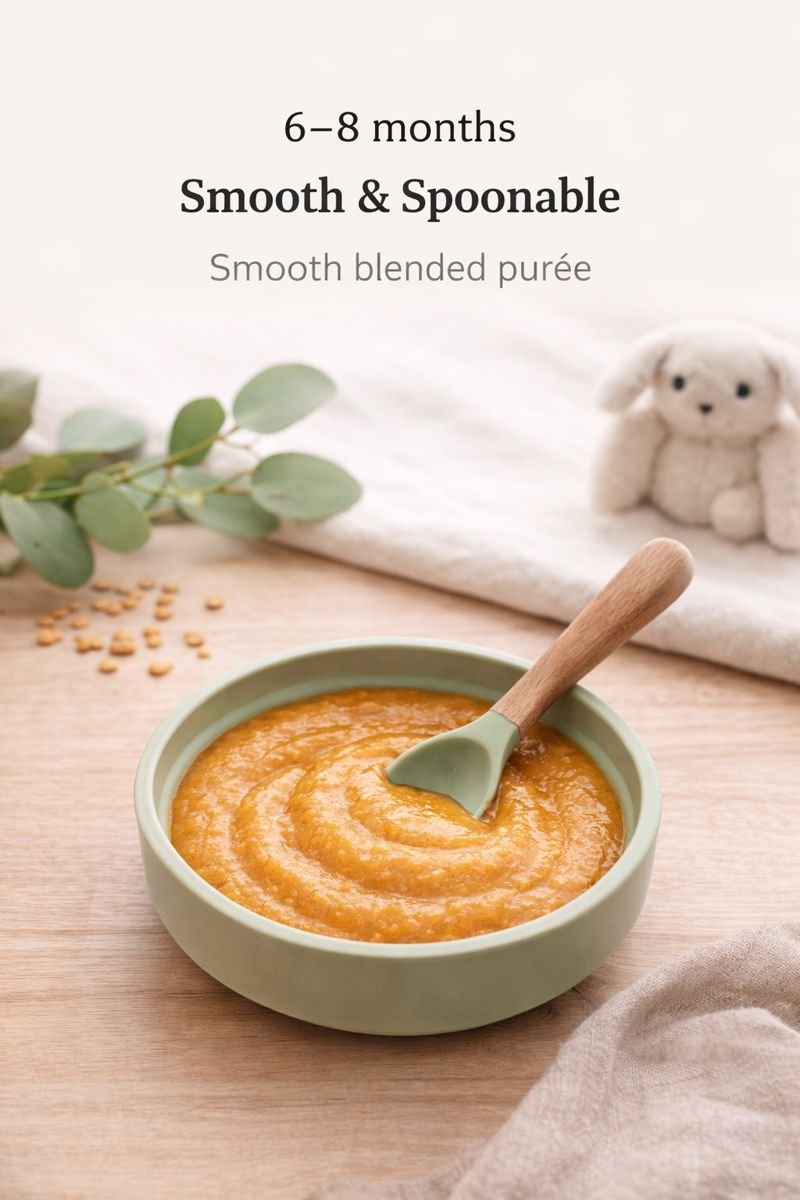
Soft, well-cooked foods blended or mashed smooth for early eaters.
Texture: purée / smooth mash
Serve: on a pre-loaded spoon or small tastes
Notes: thicker than a drink, no lumps
Examples: blended ragu + veg, smooth oats, mashed fruit porridge
Developing Chewers
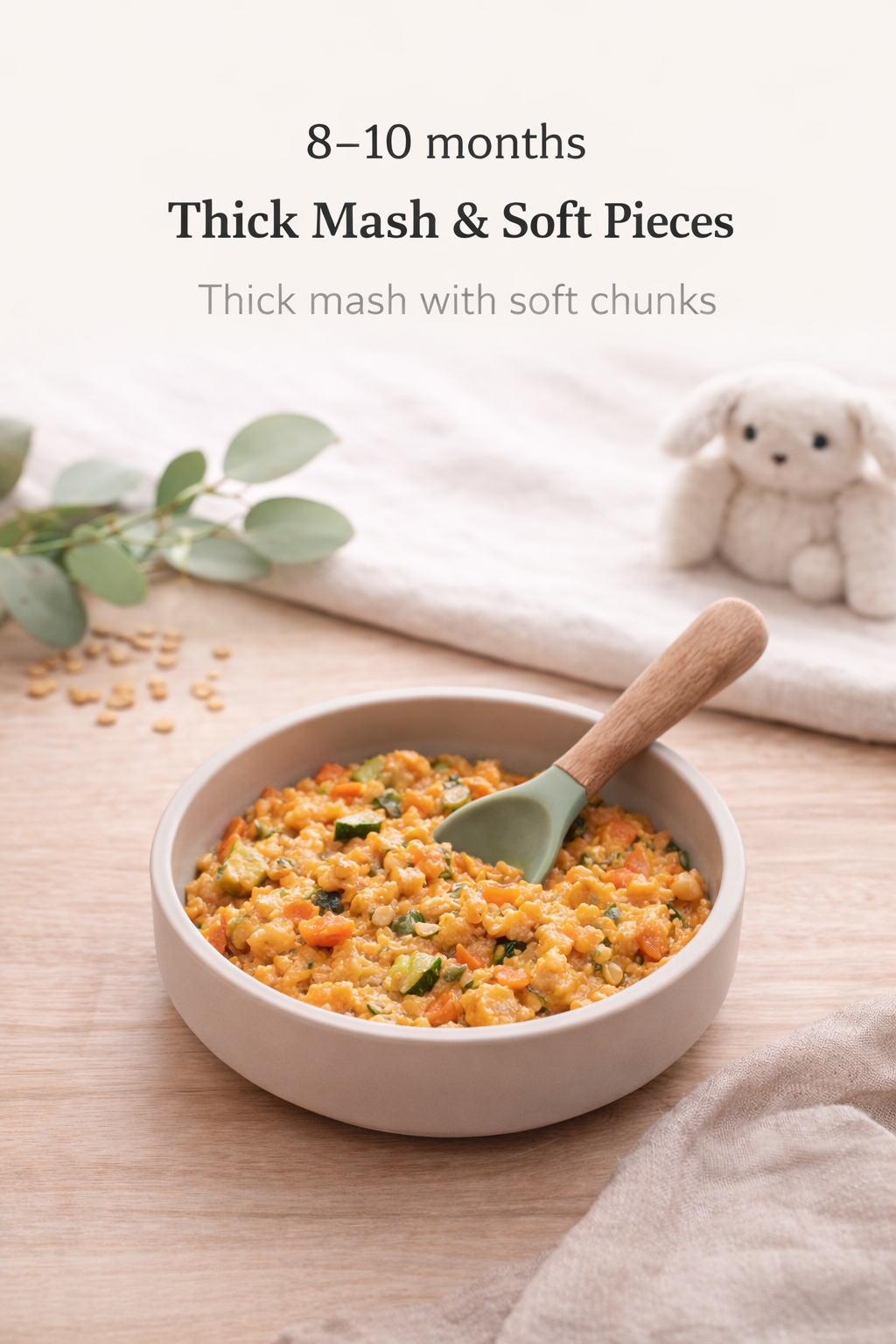
More texture to build chewing skills — still very soft and squashable.
Texture: thick mash / minced / tiny soft pieces
Serve: small spoonfuls or scoopable clumps
Notes: pieces should squash easily between fingers
Examples: chunky lentil stew, soft egg cups, shredded meat sauce
Confident Feeders

Soft, graspable pieces to encourage self-feeding and variety.
Texture: soft strips / bite-sized pieces
Serve: finger food or spoon
Notes: avoid hard rounds; cut grapes/cherry tomatoes, etc.
Examples: muffins strips, fritters, pasta shells with sauce
Allergen Disclaimer
Growing Plates meals are prepared using ingredients that may include common food allergens, including but not limited to egg, dairy, gluten, soy, wheat, fish, sesame, nuts, and legumes.
While we take care to clearly label allergens present in each meal, all foods are prepared in a kitchen that also handles allergens. As a result, cross-contact may occur, and we cannot guarantee meals are completely free from traces of allergens.
We can accommodate some ingredient substitutions on request (such as using gluten-free oats); however, all foods are prepared in a kitchen that also handles gluten, and trace amounts may still be present.
Our meals may therefore not be suitable for children with coeliac disease or severe gluten allergy.
Honey: You should never give honey in any form (raw, cooked, baked or processed) to babies under 12 months old because it can contain Clostridium botulinum spores. These spores are not destroyed even when the honey is cooked or baked.
Important Safety Notes
Always supervise your child while eating
Babies and young children are still developing the skills needed to chew, move food around their mouth, and swallow safely. Even with age-appropriate textures, choking and gagging can occur quickly and silently, especially as babies explore food independently.
Active supervision during meals is important because:
Babies may bite off pieces larger than they can manage
They are still learning to coordinate chewing and swallowing
Gagging can escalate to choking without warning
A baby may need immediate assistance if food becomes lodged
Supervision means:
Sitting with your child while they eat
Watching continuously (not checking phones or leaving the room)
Ensuring your child is seated upright and calm
Being ready to respond if they gag or choke
Eating should always be a calm, seated and closely supervised activity.
Adjust texture if your baby shows signs of difficulty
First Aid Training for Parents & Carers
While following safe feeding guidelines significantly reduces risk, no feeding approach is completely risk-free. Knowing how to respond in an emergency can make a critical difference.
We strongly encourage parents and carers to undertake a paediatric first aid course, which covers:
How to recognise choking vs gagging
What to do if a baby or child is choking
CPR for infants and children
Emergency response skills for everyday situations
Recommended First Aid Providers (Australia)
St John Ambulance – Paediatric First Aid
https://www.stjohn.org.au/first-aid-training/paediatric-first-aidAustralian Red Cross – Baby & Child First Aid
https://www.redcross.org.au/firstaid/courses/baby-and-child-first-aidRoyal Children’s Hospital (Melbourne) – Child Safety Resources
https://www.rch.org.au/kidsinfo/fact_sheets/Choking_prevention/
Completing a course can help parents feel more confident, prepared, and calm during mealtimes.